Repeatable tests
The app is designed around repeatable starts, consistent phone placement, and enough recorded data to compare one run against another. The aim is not laboratory perfection, but useful workshop feedback.
Insights / App Design
TopSpin began with a practical workshop problem: how do you compare two spinning tops using real measurements instead of feel alone? The finished app listens to vibration through the phone accelerometer, tracks rotational frequency, and turns a full spin into RPM, decay, vibration, timing, and repeatable test data.
A spinning top can look beautiful while still hiding small problems. A tiny imbalance may only appear as a shimmer, a rough bearing surface may show up as a vibration peak, and a poor launch can disguise what the top is actually capable of doing.
The app is designed around repeatable starts, consistent phone placement, and enough recorded data to compare one run against another. The aim is not laboratory perfection, but useful workshop feedback.
Raw sensor numbers are difficult to interpret on their own. TopSpin turns them into graphs that show speed, vibration, peaks, and decay in a way that can guide design changes.
The phone does not need to see the top. It feels the tiny periodic motion that reaches the phone through the test surface. TopSpin analyses that signal repeatedly, follows the most believable rotational frequency, and keeps the display focused on the measurements that are useful during a real spin.
Frequency peaks are converted into rotational speed while tracking logic helps avoid obvious harmonic jumps and unrelated vibration.
Recent RPM history is used to show how quickly speed is being lost and to estimate how the remainder of a free spin may develop.
Vibration is kept as its own measurement. A bump to the table can raise VIBES without forcing the RPM tracker to follow the disturbance.
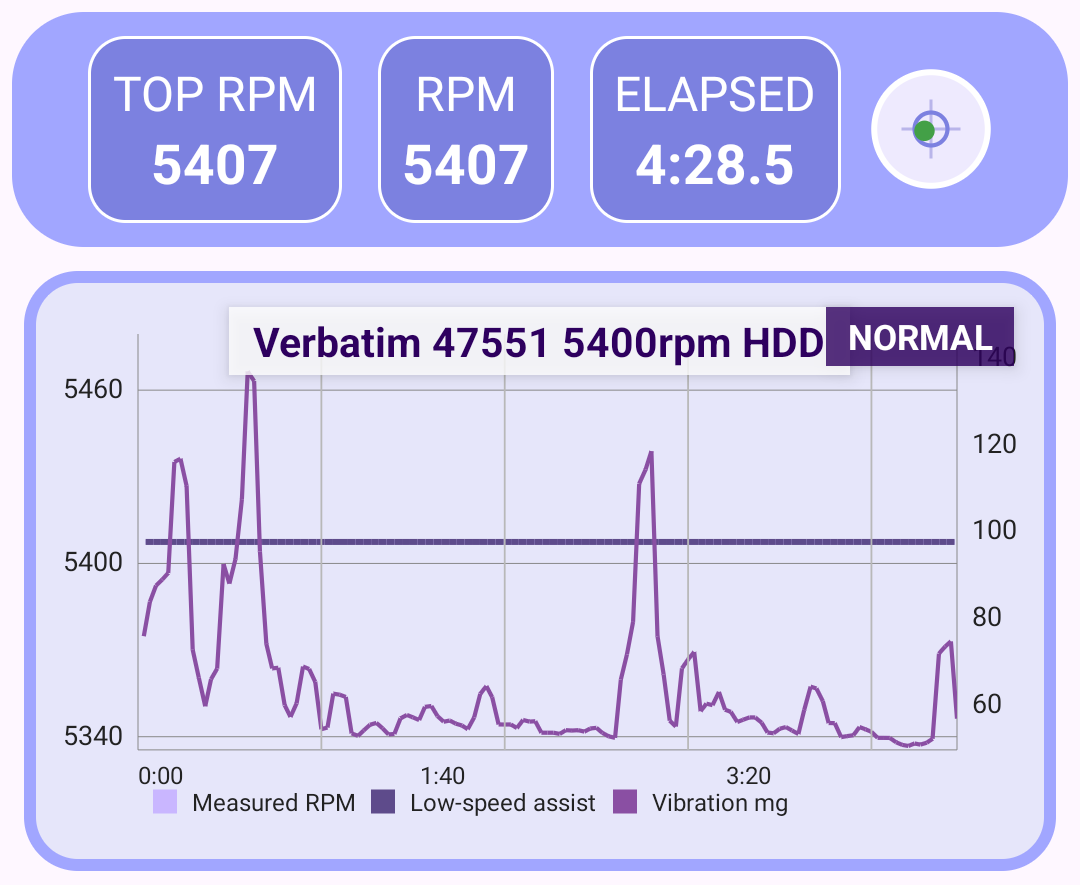
Development has never relied on a single top or a single vibration source. Fans, hard drives, motors, workshop fixtures, and other repeating vibration sources have been useful for checking frequency scale, repeatability, reacquisition, and resistance to unwanted movement.
That is not a laboratory calibration certificate. It is a practical workshop sanity check showing that the frequency scale and tracking behaviour remain consistent on an independently specified rotating source.