Angular momentum
The faster the top spins and the more effectively its mass is distributed, the stronger its resistance to disturbance becomes. This is why outer rim weight, body shape, and stem geometry all matter.
Insights / Science
A spinning top is a small, elegant physics demonstration. Its motion combines angular momentum, contact friction, material balance, vibration, and the slow loss of energy over time.
When a top is spinning quickly, its rotating mass carries angular momentum. That stored rotational motion makes the top resist being tipped over suddenly. Instead of falling straight down, it tends to lean, circle, recover, and slowly lose energy through friction and vibration.
The faster the top spins and the more effectively its mass is distributed, the stronger its resistance to disturbance becomes. This is why outer rim weight, body shape, and stem geometry all matter.
A top with more mass carried outward can store rotational energy differently from a compact design. The best shape depends on the material, size, tip, and how the top is intended to feel in motion.
The visible wobble near the end of a run is not random. It is the top losing speed, shifting its contact behaviour, and allowing gravity and friction to become more obvious. Good tops often show a calm, controlled decay rather than a harsh flutter.
The tiny contact point controls how energy leaves the system through friction, noise, and surface interaction.
Small centreline errors can create repeatable vibration signatures that become visible in sensor data.
Glass, metal, ceramic, plastic, and lens surfaces can all change sound, drag, and stability.
A phone accelerometer cannot see the top directly, but it can feel vibration that travels through the spin surface and into the phone. A rotating object tends to create repeating motion, and repeating motion has a frequency. Once the useful rotational frequency is identified, converting it to RPM is straightforward: revolutions per second multiplied by 60.
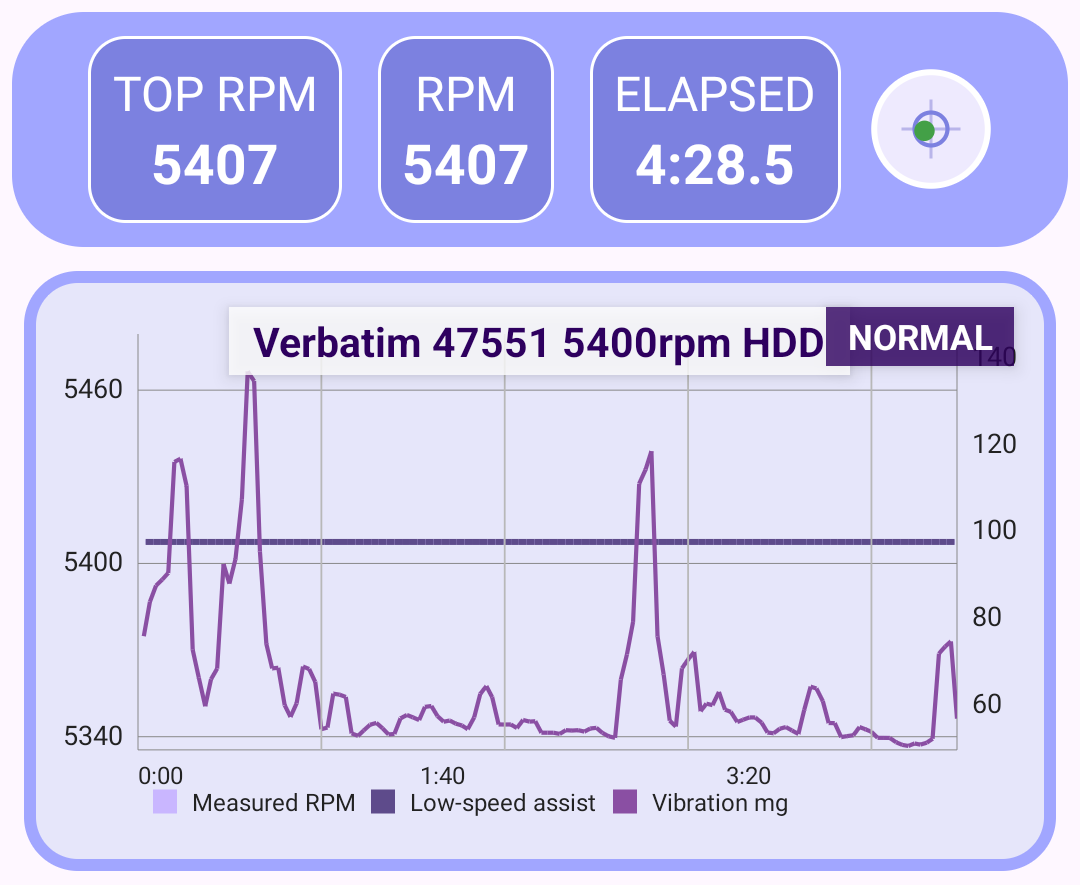
This separation is important for spinning tops. The goal is not merely to detect that something is vibrating. The useful measurement is the repeating rotational signature inside a much messier mechanical environment.